
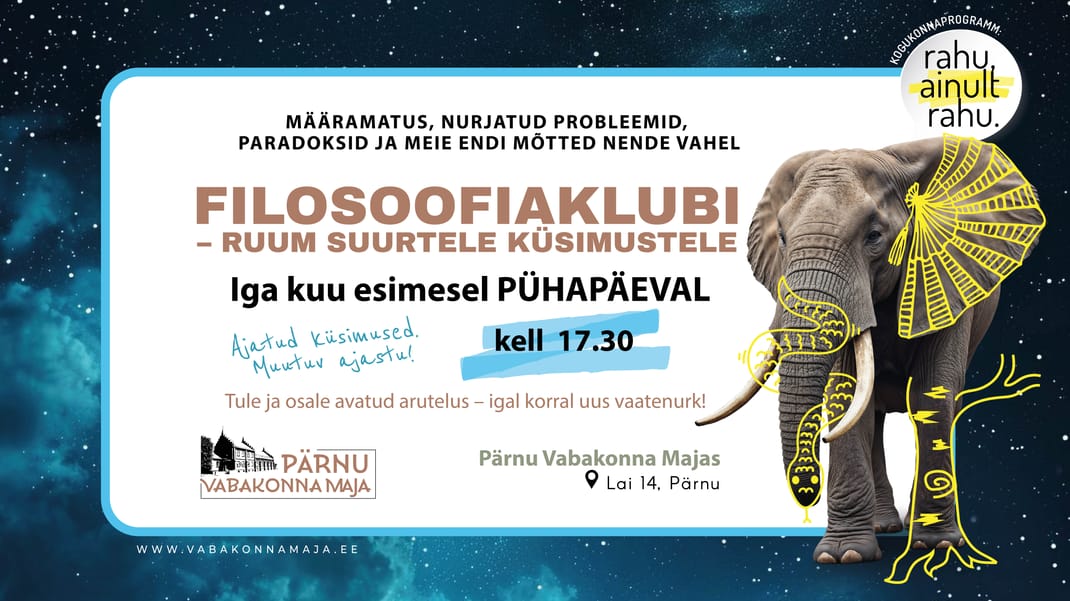
Φ Philosophy Club #08 · Growing in spirit?
- When
- Sunday 01.11.2026 · 17:30–19:30Local time (Europe/Tallinn)
- Where
- Pärnu Vabakonna Maja, Lai tänav 14, 80010 Pärnu, Pärnu maakond
- Organizer
- Pärnu Vabakonna Maja MTÜ

At our previous gathering, we found ourselves discussing the scarcity of time, family, young people’s sense of the future, freedom, values, education, culture and social responsibility. Looking back, I feel these all come together in one larger question: What kind of culture are we truly living today, and what kind are we passing on to the next generation?
Culture is not only art, literature or concerts. Culture is also what we consider normal. How we work. How we use our time. What we call success. How we raise children. What we consider important at school. What we reward and what we simply get used to.
And our time is full of paradoxes. Technology helps us work, yet there still never seems to be enough time. Education gives us more knowledge than ever before, yet we still ask whether we teach enough about being human. There is an enormous range of choices, but that does not automatically mean we know better what we want or why. We have more comforts, services and opportunities, but we spend much of our waking hours maintaining all of it.
Yes, many things have got better. The other side of something good does not make the good disappear.
As early as 1705, Bernard Mandeville wrote in The Grumbling Hive: or, Knaves Turn’d Honest about a society in which vanity, competition, the desire for luxury and the wish to have more can combine to set an extraordinarily prosperous and resourceful beehive in motion. His uncomfortable observation was that motives not considered virtues in an individual can make an entire society highly industrious and wealthy. More than three hundred years later, something about this still feels very familiar…
Tammsaare adds another uncomfortable layer. His 1934 work „Õnnelikest ja õnnetuist aegadest“ reminds us that even a better system does not automatically make people better. Having our own country did not eliminate self-interest, the lust for power, envy or other human weaknesses. Ideals are one thing; a real person, with their needs, fears and contradictions, is another. We know how to build ever more complex systems, but the same human being always comes along with them.
How often does a person ask: what, or whom, is this whole machinery for? Is the purpose of human life to become ever more skilled at operating within it—to achieve more, adapt better, make the right choices and improve our position? Or can being human mean something more expansive? Could the world be more than a place to use, organise, consume and shape around our needs? Could another person be more than a role in our life, nature more than a resource, and time more than a unit to fill as efficiently as possible?
Here I am often reminded of Jakob Hurt’s thought from 1870: “Since we can never become great in strength or numbers, we must become great in spirit, in our culture.” More than 150 years later, I think it is still a very good question. Not becoming greater only in the sense of having more, moving faster and reaching higher, but in how expansively we can perceive the world, how much responsibility we can take on, and how far our attention reaches beyond ourselves and the present day.
Hartmut Rosa uses the term resonance: a relationship with the world in which we do not try to control everything or bring it under our command, but are able to be genuinely moved by something and respond to it in turn. This might be a relationship with another person, our work, nature, music, a place, history or a great question—something whose value does not depend only on how useful, measurable or profitable it happens to be.
Perhaps, in our time, Hurt’s call to “become great in spirit” could mean that a person’s world grows larger than their own comfort, success and immediate needs. And if we look at it this way, can we see hope?
We do not have to wait for the whole world to change. Culture grows from what we ourselves pay attention to, what we show our children, which relationships and places we care for, and which rules of the game we refuse to take for granted within our own sphere of influence.
That is what we would like to reflect on together at the next Philosophy Club gathering. What in our current culture is worth preserving and passing on? What could our generation confidently let go of? And where, amid these large-scale processes, is our own genuine scope for action?
Come with your experiences, questions and thoughts. You do not need to have ready-made answers—the interesting thing is to see whether something shared begins to emerge from different perspectives.
We’ll meet on 1 November at 17:30 at Pärnu Vabakonna Maja, Lai 14.
Meeting organiser Agnes Sirg: “I have tried to understand where we come from, where we are now and where we are going. I have simply observed, talked with people and explored different approaches and worldviews, some inspiring, some bleak. What interests me most is what to do with this knowledge and these insights—including my own—in life.”
Participation is free, but please register on Fienta. Places are limited so the discussion can remain a circle where everyone has the chance to share their thoughts if they wish. If you have time, you can also bring a little something for the shared table!
Φ Time and place
Sunday, 1 November 2026, 17:30–19:30
Pärnu Vabakonna Maja, Lai 14, Pärnu
ΦΦΦΦΦΦΦΦΦΦΦΦΦΦΦΦΦΦΦΦΦΦΦΦΦΦΦΦΦΦΦΦΦΦΦΦΦΦΦΦΦΦΦΦΦΦΦΦΦ
What kind of place is the Philosophy Club?
The Philosophy Club is a place for people who can’t help asking, again and again, why we live the way we do :) For those who notice how our ideas and social norms change over time and are curious about what shapes those changes. For people who have reflected on human nature, consciousness, the meaning of life or how society works, and developed personal understandings through their life experience, reading or spiritual searching. For those who want to keep exploring these questions and hear what conclusions others have reached.
Very different worldviews and philosophies of life can meet around our table. Those differences are interesting to explore when we want to understand one another’s reasoning. The Philosophy Club takes its shape from the questions, observations and experiences of its participants. We hope everyone will bring something from their own world of thought to the discussion. It might be a carefully considered position, a contradiction they have not yet been able to explain, or a question they can hardly put into words.
You do not need a background in philosophy or familiarity with any particular school of thought, but if you have either, you are very welcome! What matters is a genuine interest in understanding the world and ourselves, and a wish to think a little further together with others.
At each gathering, there is one focus topic and one facilitator. At the end, we agree together on what to discuss next time and ask whether anyone would like to lead the next discussion (this is voluntary). We meet once a month, on the first Sunday of each month!
Pärnu Vabakonna Maja
Lai 14, Pärnu
info@vabakonnamaja.ee
554 5412
(Parking in the Europark area: 2 hours free with a parking disc. Paid parking by SMS to 1902 (car registration number) EP 74 – 30 min / €1, full day €8.)
Information comes from the event source. Check changes with the organizer.