
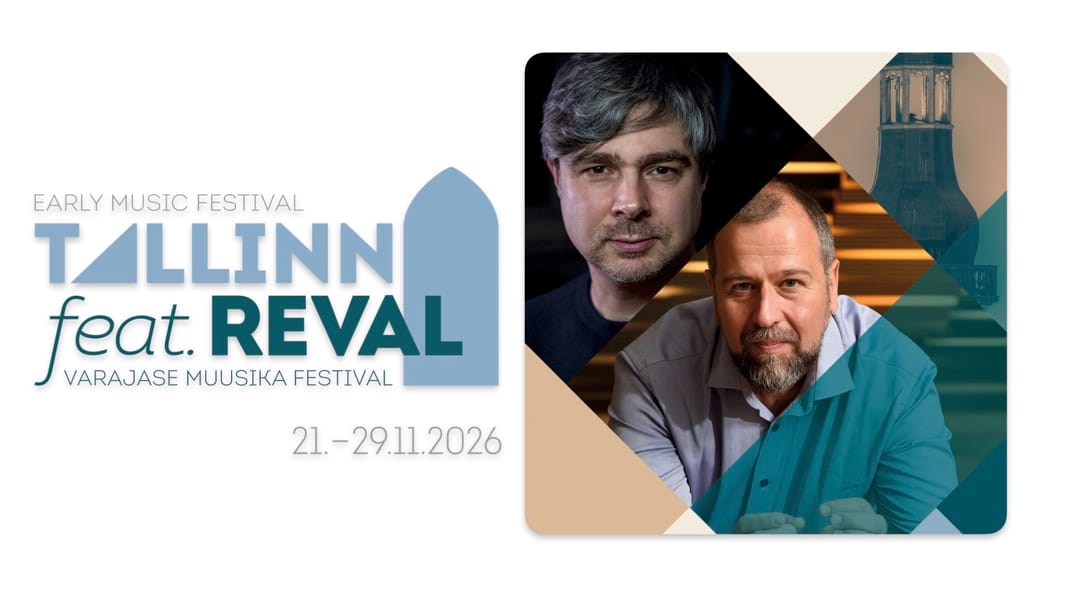
IX Tallinn feat. Reval – Experimental Baroque
- When
- Thursday 26.11.2026 · 19:00–20:15Local time (Europe/Tallinn)
- Where
- Otepää Kultuurimaja, Virulombi tänav 2, 67404 Otepää, Valga maakond
- Organizer
- varajase muusika stuudio Cantores Vagantes MTÜ

Programme: J. Klein der Junger, J. S. Bach, G. Ph. Telemann, J. Ph. Rameau
Pavel Serbin – baroque cello (Hungary)
Reinut Tepp – harpsichord
This programme is dedicated to the baroque cello repertoire and to composers of the 18th century exploring new compositional techniques and contexts. As a solo instrument, the cello was still a fairly new phenomenon at the time: the first printed cello sonatas appeared in Italy around 1697. It took time for composers to take the instrument seriously. The second printed “oeuvre” was a collection of sonatas for the Basse de violon (one of the names then used for the cello), published in Amsterdam in 1717 by the Dutch businessman Jacob Klein der Jünger. Klein called himself an amateur, but he was a highly accomplished cellist and a composer of extraordinary imagination, whose compositional fantasy seemed to know no bounds. Taking Corelli’s stylistic model as his guide, he drew on features of the older 17th-century stylus phantasticus. His innovative harmonic ideas are combined with the cello’s various discordato tunings.
The programme’s second theme is the art of transcription. We have chosen a brilliant but today little-known collection for two cellos (cello and basso continuo), published in Paris around 1750. It contains well-known folk tunes arranged by an unknown author (for example, “Fürstemberg”), as well as excerpts from Rameau’s operas. The pieces have not simply been transposed into another key and adapted for cello; the melodies have also been varied and modified.
The programme’s third theme is a contemporary experiment with transcriptions. The aim has not been to recomposed a work or turn it into a collage, as Michael Nyman (born 1944) has done, for example, but to seek out its historical background. Among G. Ph. Telemann’s 12 fantasias for viola da gamba, four may originally have been intended for cello. “Bringing them back” to their presumed original form is therefore a challenge in itself. In J. S. Bach’s Suite No. 2, we seek to bring out its French style by placing it in the form of French pièces de viole, usually performed with continuo bass—in this case, “for two cellos and harpsichord” (concert pour deux violoncelles et clavecin).
For more information about festival concerts requiring tickets, free-entry or museum-ticket youth concerts, masterclasses, workshops and meetings, visit the festival website: www.tallinnfeatreval.eu
Information comes from the event source. Check changes with the organizer.