
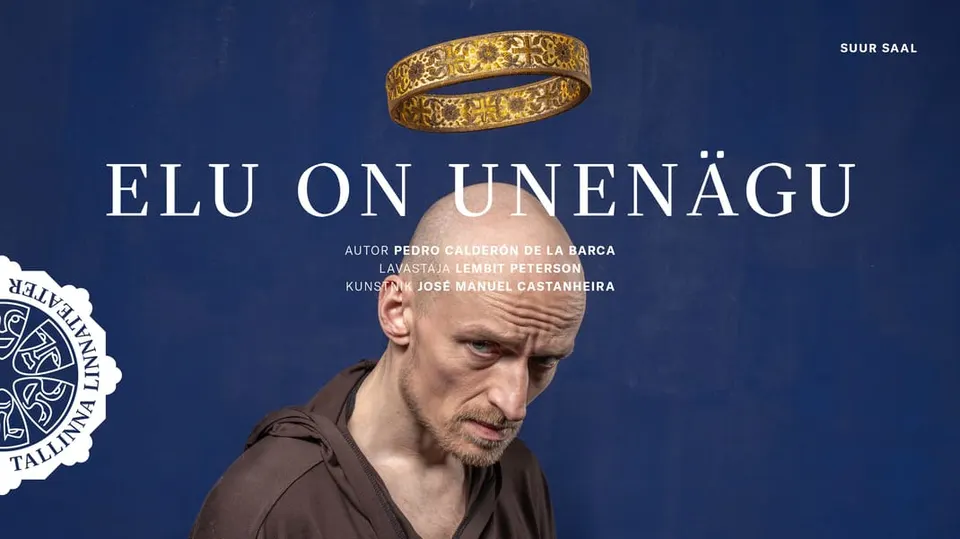
Life Is a Dream
Original title: Elu on unenägu
- When
- Tuesday 12.01.2027 · 18:00–22:20Estonian time
- Organizer
- Tallinna Linnateater
- Price
- from €20
Add to calendar

Author: Pedro Calderón de la Barca
Director: Lembit Peterson
Set designer: Jose Manuel Castanheira (Portugal)
Assistant set designer: Rui Manuel Francisco (Portugal)
Costume designer: Riina Vanhanen
Lighting designer: Margus Vaigur (Endla)
Video designer: Tom Tristan Kidron
Composer: German Diaz (Spain)
Choreographer: Eve Mutso
Assistant choreographer: Eva Lotta Kliimask
Translator: Jüri Talvet
Cast: Kaspar Velberg, Kristo Viiding, Kristjan Üksküla, Rain Simmul, Indrek Sammul, Sandra Uusberg, Maria Ehrenberg, and Rea Haljasmäe, Helo Kaplinski, Karel Käos, Karl Aleksander Lilje, Sundari Lüllmann, Mari Jete Mere, Anna-Magdalena Peterson, Jonathan Peterson, Klara Helena Peterson, Maximilian Rootsmäe, Eerik Song and Simone Süvari
“Life Is a Dream,” from Spain’s Golden Age, is one of the most influential plays of the European Baroque. It has been performed and staged across the centuries in a wide variety of cultural contexts. At the heart of the play is Basilio, a fictional king of Poland, who is convinced by a prophecy that his son Segismundo will grow up to be a tyrant and a patricide and bring about the kingdom’s downfall. Acting on this belief, the king has his newborn son imprisoned in a lonely tower in the mountains. Years later, however, his conscience begins to trouble him. Segismundo is put to sleep with the help of drugs and brought to the palace so that his behaviour can be put to the test.
In his play, Calderón addresses not only political power and individual fate, but also raises universal questions about human freedom and responsibility, and the nature of reality. “Life Is a Dream” is an allegorical verse drama in which the Baroque view of the world—life’s transience, illusion and mutability—is intertwined with early modern philosophical debates about free will. Calderón’s famous motif that human life resembles a dream does not lead to nihilism, but to ethical responsibility: because truth is uncertain, moral choice becomes all the more important. It is this tension of ideas and poetic depth that make the play a timeless work, one that speaks to audiences today as well.
Premiere on 8 May 2026 in the Great Hall.
Information comes from the event source. Check changes with the organizer.