
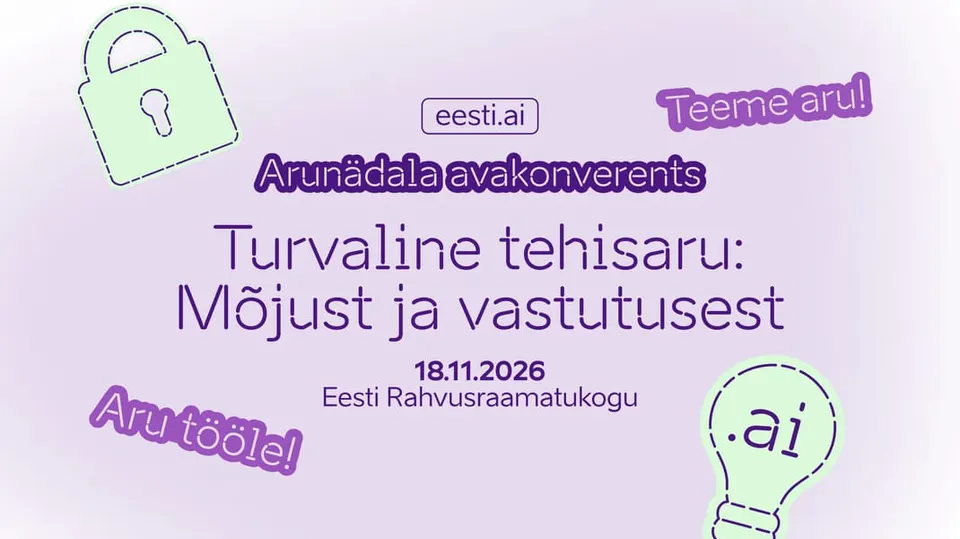
Arunädala Opening Conference: Safe AI — Impact and Responsibility
- When
- Wednesday 18.11.2026 · 12:00–16:30Local time (Europe/Tallinn)
- Where
- Eesti rahvusraamatukogu, Tõnismägi 2, 10122 Tallinn, Harju maakond
- Organizer
- Eesti.ai algatus

Arunädala opening conference: “Safe AI: Impact and Responsibility”
AI offers ever more opportunities, but how can we use it wisely and safely? What risks should we take into account, and how can we mitigate them? Who is responsible when AI gets something wrong? What is the role of humans in a world where AI can do more and more? These are the questions we will examine at the Arunädala opening conference.
On 18 November, we will bring experts and entrepreneurs together at the Estonian National Library to discuss the safe and responsible use of AI and its broader impact. We will explore how to manage risks consciously, what value AI creates for the Estonian economy, and how it is changing our work culture and society more broadly.
During the day, we will address two major questions.
Part 1: How can we turn risks into opportunities?
The use of AI and awareness of its risks must develop hand in hand. Drawing on the TI-Hüpe risk analysis, we will discuss the risks associated with AI and ways to prevent and mitigate them. We will talk about privacy and cybersecurity, and consider how to preserve human decision-making authority and responsibility when using AI. The first half of the day will conclude with a panel discussion on the ethical and legal dilemmas of AI.
Part 2: How will the adoption of AI change Estonia’s economy and society?
In the second half of the conference, we will look at how AI is changing the way companies work. Drawing on companies’ experiences and research findings, we will also examine how AI affects productivity, jobs, skills needs and Estonia’s competitiveness. We will discuss broader changes too: whether AI will help reduce or increase inequality, the role of major technology companies, and how to balance rapid technological development with responsible decisions.
Opening conference programme
11.00 Doors open
12.00 Conference opening | Katrin Isotamm, Head of the Public Engagement strand of the Eesti.ai initiative
12.15 Key findings of the TI-Hüpe risk analysis | Margit Sutrop, Head of the University of Tartu Centre for Ethics and Professor of Practical Philosophy
12.30 Mitigating risks: measures taken and planned | Ivo Visak, Head of TI-Hüpe
12.45 Privacy and cybersecurity | Tanel Mällo, Researcher at Cybernetica AS
13.10 Panel discussion: “Who is responsible when AI gets something wrong?” | Ivo Visak, Tanel Mällo, Katrin Laas-Mikko, Head of Risk Management and Compliance at SK ID Solutions
13.55 Summary of Part I
14.00 Break
14.30 What changes in a company?
14.50 Can AI make Estonia more productive? | Mari-Klara Stein, Professor of Organisation and Management, TalTech Institute of Business Administration
15.05 Conversation: “What remains for humans when intelligence becomes cheap?” | Kaspar Korjus, Co-founder and CEO of Pactum AI; Daniel Vaarik, Founder and CEO of Levila
15.40 Panel discussion: “AI’s impact on Estonia’s economy and society” | Mari-Klara Stein, Kaspar Korjus, Daniel Vaarik
16.20 Summary of Part II
The conference will be moderated by Lembit Loo, founder of Portata.ai and a technology and business leader with more than 20 years of international experience. He helps companies adopt AI strategically, trains leaders and teams as part of the Eesti.ai programme, and is a member of TalTech’s AI Council. He is also the creator and host of the Estonian General Intelligence podcast.
Attendance
The conference is free for everyone who registers. Places are limited.
The conference opens the nationwide Arunädala, taking place from 18 to 22 November. The week will feature practical AI workshops, conferences, discussions and other events. Arunädala aims to increase public awareness of AI and support its informed, safe and effective use.
Explore the Arunädala programme: Arunädala, 18–22.11.2026 | Eesti AI
The organiser reserves the right to make changes to the programme.
Information comes from the event source. Check changes with the organizer.