
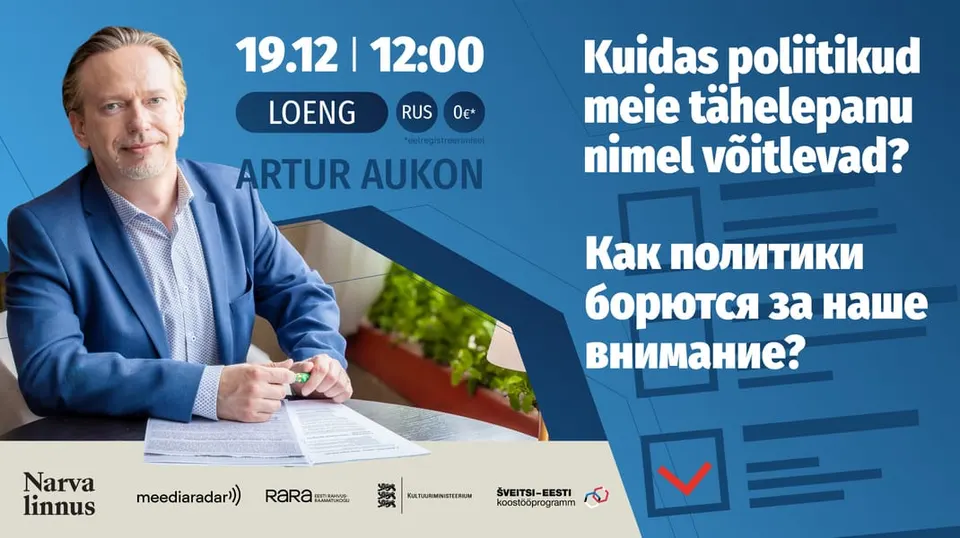
Interactive lecture | How politicians compete for our attention: populism, PR and news manipulation
- When
- Saturday 19.12.2026 · 12:00–13:30Local time (Europe/Tallinn)
- Where
- Narva Muuseum, Peetri plats 7, 20308 Narva, Ida-Viru maakond
- Organizer
- SA Narva Muuseum

Narva Muuseum invites everyone interested to another free lecture as part of the MeediaRadar project. After the lecture, the discussion will continue over coffee and light refreshments.
In political communication, simple answers to complex questions, forceful messages and grand promises are becoming increasingly common. Where is the line between conventional political communication and populism? How do individual statements and conflicts become the most important news of the day? And why do some political messages resonate with people more than others?
Using examples from Estonia and other European countries, we will explore how to recognise manipulation, distinguish important information from political and media noise, and assess politicians’ promises critically.
Artur Aukon, a journalist and communications expert with 25 years of media experience, will guide us through the fascinating world of political intrigue and manipulation. He worked for many years as an editor and presenter at Raadio 4 and with ETV+ and ERR, covering Estonian politics and elections. In recent years, he has been actively involved in political communication and has delivered media literacy and information security training.
Everyone interested is welcome to join the discussion and share their thoughts!
Lecture duration: 90 minutes. The event will be held in Russian. Admission is free, but registration is required. Places are limited.
This is a public event that will be recorded for publication purposes.
The event is supported by the MeediaRadar project (2024–2028) of the Swiss-Estonian Cooperation Programme, carried out in cooperation with the National Library and the Ministry of Culture. The project is co-financed by Switzerland to reduce economic and social disparities in the European Union.
Information comes from the event source. Check changes with the organizer.